

Pi Network Spotlights SoloHost's Local AI Potential

Pi Network's SoloHost framework brings local AI agents, OpenClaw, and the Atlassian MCP Server to Pi Desktop, giving Pioneers more control over computing while reducing reliance on centralised cloud services.
(Advertisement)

SoloHost Turns Pi Desktop Into a Local Computing Platform
Pi Network is broadening what its users can do with Pi Desktop through SoloHost, an open and permissionless framework that lets third-party developers publish self-hosted applications for Pioneers to discover, install, and run directly on their own machines.
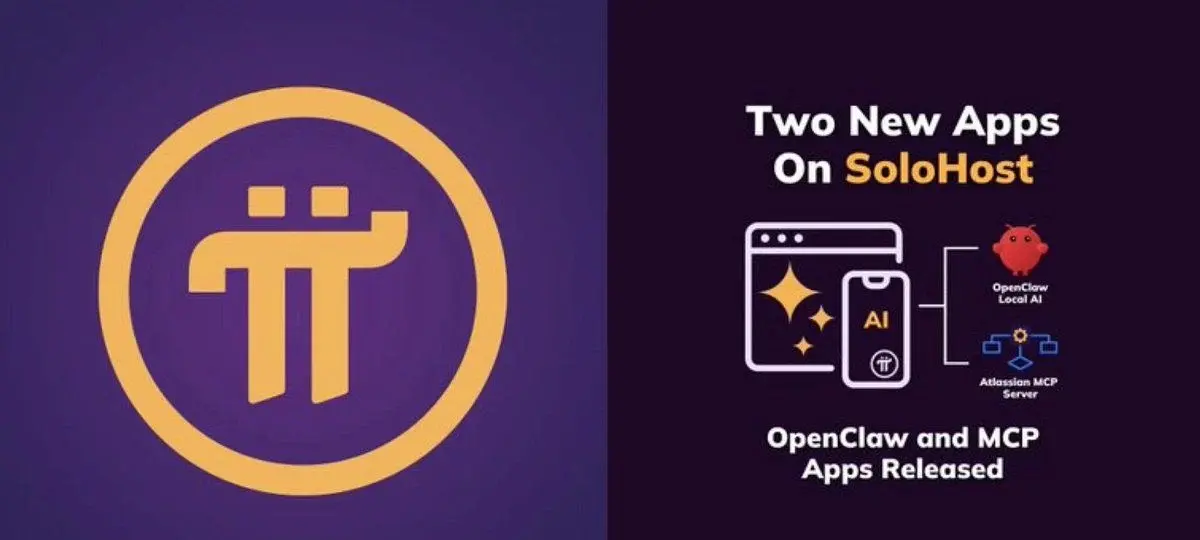
According to Pi Network's official blog, the OpenClaw and Atlassian MCP Server apps are now featured in SoloHost on Pi Desktop, released alongside Node software version 0.6.2. OpenClaw is a local AI agent that can operate on either a locally hosted model or external providers such as ChatGPT and Claude. When running through SoloHost, it operates inside a restricted container that limits its default access to the wider computer, offering a more controlled setup. The Atlassian MCP Server, meanwhile, targets developers and product teams who want to connect AI tools directly to Jira workflows.
The additions build on Hermes, Pi Network's earlier open-source local AI agent that runs and stores all data on the user's own device. Together, they illustrate a clear pattern: SoloHost is positioning Pi Desktop as a privacy-first environment where AI tools process data locally, without routing it through centralised cloud servers.
Beyond Blockchain: A Larger Ambition for Pi Nodes
The SoloHost push is part of a broader effort to give Pi's desktop infrastructure a purpose beyond blockchain consensus. Pi Network has said the platform could eventually draw on its network of more than 420,000 Pioneer-operated Nodes for distributed computing workloads, with Node operators able to earn $PI by contributing spare processing capacity to third-party clients.
That ambition moved a step closer in August 2026. Pi Network completed a proof-of-concept distributed computing test using five volunteer Node operators, with each device processing jobs sent automatically through the network and reporting results back without manual intervention. Pi said the process worked end to end, from job assignment through to completion. Full-scale distributed computing across the Node network remains under development, and reliable operation at scale has not yet been demonstrated.
For Pioneers already running Pi Desktop and Nodes, SoloHost represents a practical extension of hardware they already own, shifting those machines from single-purpose blockchain tools into a broader local computing layer that can run AI agents and specialised self-hosted software.
Sources:
Pi Network Official Blog: New SoloHost Apps
Pi Network Official Blog: Pi Node 0.6.2 Release
Coinpedia: What Node 0.6.2 and the Computing Test Actually Mean
(Advertisement)
Latest News





Read More...





Author
 Soumen Datta
Soumen has been a crypto researcher since 2020 and holds a master’s in Physics. His writing and research has been published by publications such as CryptoSlate and DailyCoin, as well as BSCN. His areas of focus include Bitcoin, DeFi, and high-potential altcoins like Ethereum, Solana, XRP, and Chainlink. He combines analytical depth with journalistic clarity to deliver insights for both newcomers and seasoned crypto readers.