

Vitalik Bets Against AI Breaking Bitcoin Security

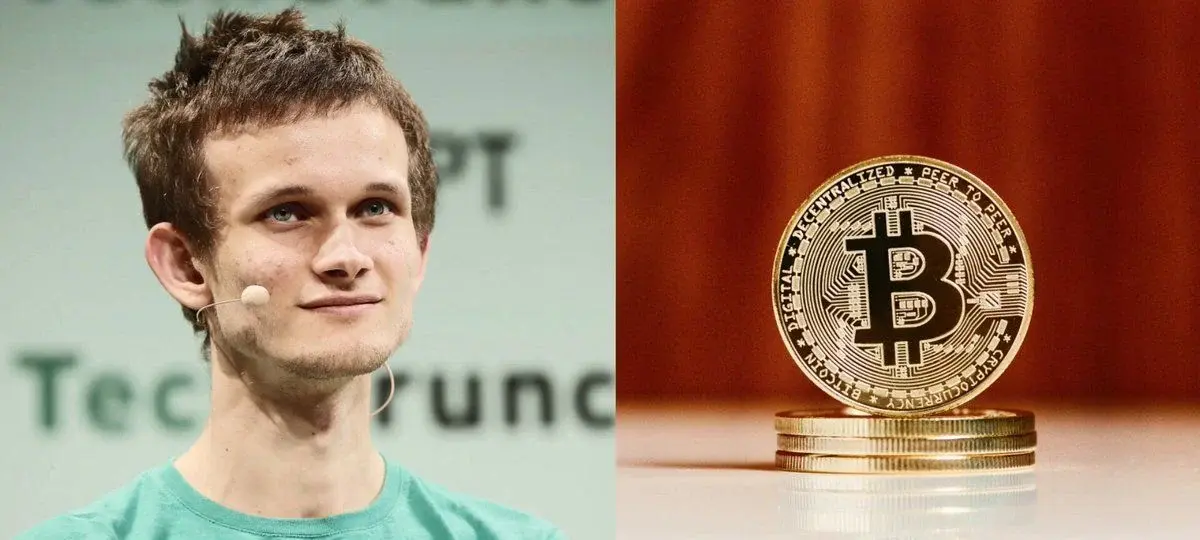
Ethereum co-founder Vitalik Buterin pushes back on predictions that AI could crash Bitcoin by more than 50%, calling risks to its core proof-of-work cryptography tiny and saying software upgrades are sufficient to handle network-level threats.
(Advertisement)

Buterin Takes the Opposite Side
Ethereum co-founder Vitalik Buterin has firmly rejected a prediction that advances in artificial intelligence could seriously undermine $BTC security. The warning came from angel investor Liron Shapira, who assigned a 50 percent confidence level to his prediction that Bitcoin would suffer a decline of over 50 percent because AI could weaken what users consider the network's security or robustness. Shapira's argument centres on the idea that rapidly advancing AI systems could discover weaknesses in SHA-256 hashing or other cryptographic primitives that secure the Bitcoin network.
Buterin said he had "already taken this bet," noting that around 90 percent of his net worth is already exposed to crypto. He made clear he stands on the other side of Shapira's thesis. He said the chances of Bitcoin's hash functions and proof-of-work system being rendered ineffective are a "tiny" risk and that Bitcoin can patch the rest.
Software Upgrades, Not Social Consensus
Buterin's response focused on Bitcoin's technical adaptability rather than its market price, arguing that most AI-related threats could be addressed without changing the network's core social agreement. He split the risk into two buckets: mining-pool infrastructure and the peer-to-peer layer, which developers and node operators can patch without changing Bitcoin's rules, and a genuine break of SHA-256 or proof-of-work, which he places in the "tiny" probability category.
Buterin's position is that AI will make both attackers and defenders stronger, but defenders hold structural advantages when it comes to cryptographic security. Breaking encryption is computationally brutal, while verifying it is comparatively cheap. That asymmetry, in his view, is decisive.
In a separate thread on the same night, Buterin pointed to the speed at which new techniques for succinct proofs (SNARKs) and fully homomorphic encryption (FHE) have arrived, particularly in 2026, as further evidence that the defensive side of cryptographic security is advancing rapidly.
After Buterin weighed in, alongside AI researcher Eliezer Yudkowsky, Shapira subsequently reduced his probability estimate from 50 percent to 40 percent. The exchange, which played out publicly on September 7, represents the most direct rebuttal to AI-based Bitcoin security concerns from a major figure in the crypto industry to date.
Sources:
Coinpedia: Vitalik Buterin Rejects AI Warning That Bitcoin Could Crash 50%
Crypto.news: Bitcoin unlikely to crash 50% on AI risks, Buterin says
Crypto Briefing: Vitalik Buterin rejects claims AI could crash Bitcoin by 50%
(Advertisement)
Latest News



Read More...



Author
 Soumen Datta
Soumen has been a crypto researcher since 2020 and holds a master’s in Physics. His writing and research has been published by publications such as CryptoSlate and DailyCoin, as well as BSCN. His areas of focus include Bitcoin, DeFi, and high-potential altcoins like Ethereum, Solana, XRP, and Chainlink. He combines analytical depth with journalistic clarity to deliver insights for both newcomers and seasoned crypto readers.