

CLARITY Act Could Turn Banks Into Crypto Players

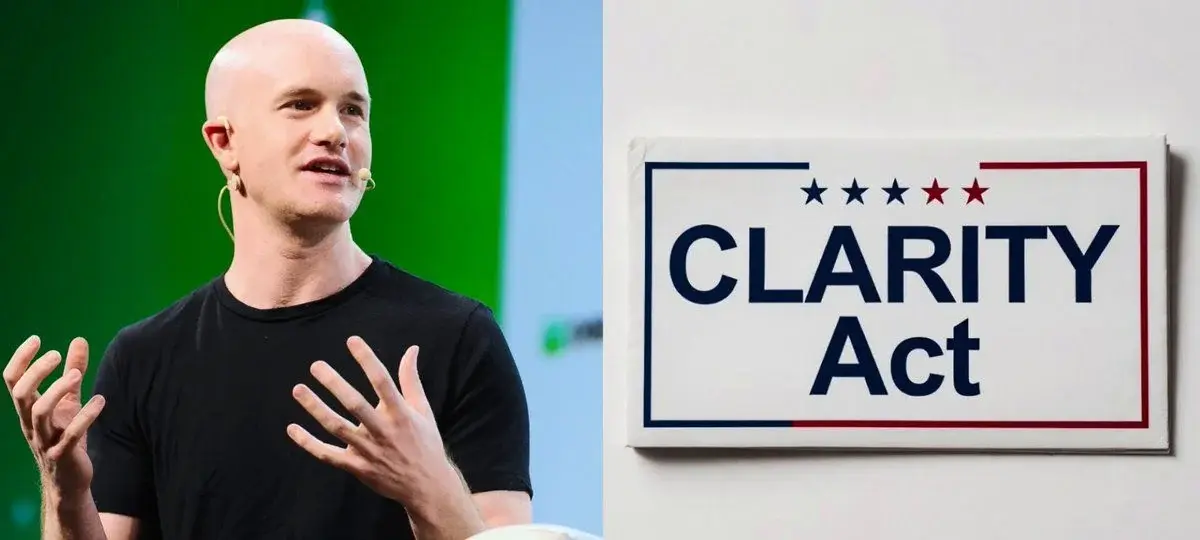
Coinbase CEO Brian Armstrong says the CLARITY Act gives banks clearer crypto rules and argues most banks will treat regulation as an opportunity, not a threat, ahead of the critical September 15 Senate vote.
(Advertisement)

Armstrong Makes the Case for Clearer Rules
Coinbase CEO Brian Armstrong is stepping up his push for the CLARITY Act, arguing the legislation would give banks and crypto businesses the regulatory certainty they have long been waiting for. Speaking ahead of a critical Senate procedural vote scheduled for September 15, Armstrong said the bill represents the product of extensive bipartisan negotiations and that "most banks realize that's not a threat, it's an opportunity."
Armstrong said the legislation could help address concerns around consumer protection, law enforcement, and regulatory oversight. He has also highlighted that the bill contains specific provisions designed to expand what banks can do with digital assets, including new authorities to integrate stablecoins and grow their businesses. Armstrong told Fox Business that he speaks with many bank CEOs who are leaning into crypto as an opportunity, and that they are integrating stablecoins as fast as they can while responding to client demand for crypto assets.
He has presented the vote as a choice between bringing digital assets under American supervision and allowing more activity to move offshore. That framing is central to his broader argument: that without a clear domestic framework, crypto businesses will continue to operate in jurisdictions where US regulators have little reach.
Where the Bill Stands
The CLARITY Act is the furthest-advanced attempt to settle US crypto's defining question of whether a token answers to the SEC or the CFTC. It routes decentralised digital commodities to the CFTC and keeps fundraising and investment contracts with the SEC. The bill passed the House in July 2025 by a vote of 294 to 134. It then cleared the Senate Banking Committee in May on a 15-9 vote, the first time a broad digital asset regulatory framework had passed a congressional committee.
Beyond that regulatory split, the CLARITY Act would replace the state-by-state patchwork of money transmitter licenses with a single federal registration, the kind of registration many institutional counterparties demand before they trade at scale.
Not everyone agrees with Armstrong's framing, however. The banking sector has objected to language in the bill permitting crypto exchanges to offer yield on stablecoin balances, warning that such rewards would siphon customer deposits from conventional lenders. The bill needs at least seven Democratic votes to pass the full Senate, and many Democrats oppose it, arguing its anti-money laundering provisions are too weak and that it should bar political officials from profiting from crypto ventures.
The Senate delayed a floor vote ahead of the August 2026 recess due to partisan disagreements over ethics rules and banking opposition, scheduling a procedural vote for September 15, 2026, a cloture vote on the motion to proceed that requires 60 votes to overcome a filibuster. Armstrong told CNBC on August 20 that Senate Majority Leader Thune "would not have scheduled this on September 15 if he didn't think it would pass," and argued that "both sides got 90% or so of what they want." The September 15 vote will be a key test of whether that optimism is well founded.
Sources:
CoinDesk: U.S. Senate Opens First Stage of Clarity Act Voting
Crypto Times: Coinbase CEO Says Banks See CLARITY Act Opportunity Ahead of September 15 Vote
Latham and Watkins: US Crypto Policy Tracker, Legislative Developments
(Advertisement)
Latest News




Read More...


Author
 Soumen Datta
Soumen has been a crypto researcher since 2020 and holds a master’s in Physics. His writing and research has been published by publications such as CryptoSlate and DailyCoin, as well as BSCN. His areas of focus include Bitcoin, DeFi, and high-potential altcoins like Ethereum, Solana, XRP, and Chainlink. He combines analytical depth with journalistic clarity to deliver insights for both newcomers and seasoned crypto readers.